01
Set the audit question before building the checklist
Restaurant audits are used for different purposes. A food-safety inspection tests regulatory and hygiene requirements. A financial audit examines records and controls. A brand audit tests compliance with a defined concept. A restaurant operational audit asks a different question: can the people, workflows and management routines reliably deliver the intended guest and commercial outcome?
Define the decision the audit must support. Leadership may need to understand falling review scores, inconsistent service between shifts, rising labour without better throughput, repeated kitchen delays, weak handovers or performance differences across locations. That question determines what should be observed and which evidence matters.
Keep specialist boundaries clear. Operational observation can reveal that a control is missing or inconsistently followed, but it does not replace a qualified food-safety, legal, accounting or technical inspection where one is required. A useful scope states both what the audit covers and what it does not certify.
- The business question leadership needs answered
- The outlets, shifts and demand conditions in scope
- The guest, team and commercial outcomes to examine
- The records and operating data available for context
- Any specialist compliance reviews that remain separate
02
Observe the complete operating cycle
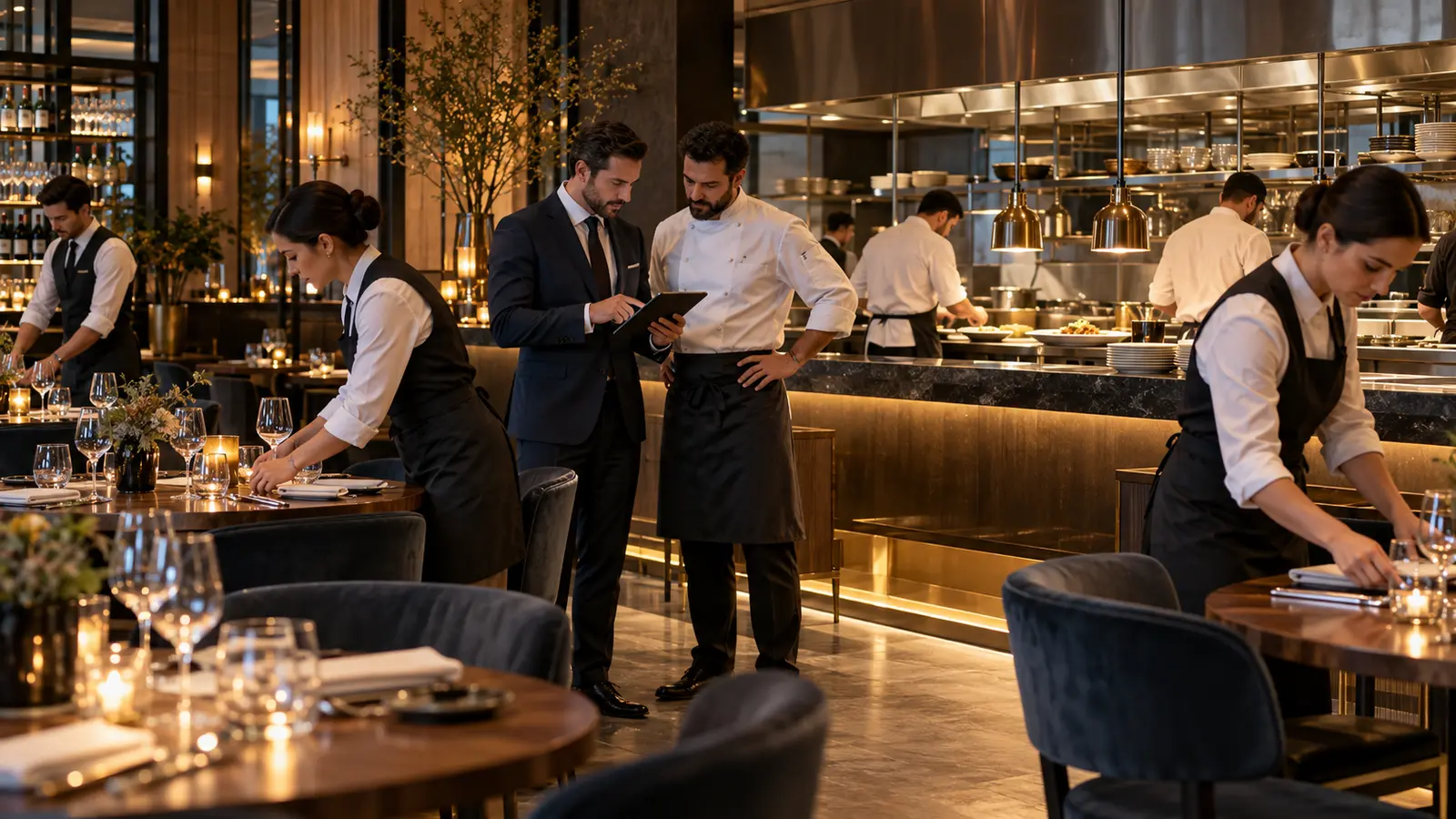
A dinner service cannot be understood by watching the dining room for one hour. Begin before opening and follow the operation through preparation, briefing, service peaks, recovery, closing and the next handover. Readiness decisions made hours earlier often determine what guests experience later.
Sample more than one condition. Include a quiet period, a representative service and a credible peak. If delivery, private events, terraces or bar service materially change the workload, include them. The purpose is not to catch employees making mistakes; it is to test whether the operating model remains clear when demand and exceptions increase.
Record the context with every observation: time, covers, staffing, section, order channel, unusual constraints and the stage of service. Context prevents an isolated delay from becoming a general conclusion and helps repeated patterns become visible.
03
Audit the guest journey as one connected experience
Guests do not separate reservations, reception, table service, kitchen and payment into departments. They experience one visit. Follow selected journeys from booking or walk-in through arrival, seating, ordering, meal pacing, issue recovery, payment and departure.
At each stage, compare the intended experience with the observable outcome. Was the guest recognised? Did information move without repetition? Was the menu explained accurately? Did courses arrive in a coherent rhythm? Did somebody own a request until it was complete? Did the departure leave the relationship stronger?
Look beyond scripted language. Genuine hospitality depends on attention and judgement, but those qualities still need operational support. A server cannot be attentive while searching for stock, resolving unclear table ownership or waiting for a routine approval. The audit should connect the human experience to the system behind it.
- Reservation accuracy and pre-arrival information
- Welcome, waiting and table ownership
- Menu knowledge, ordering and expectation setting
- Meal pacing and front-to-back communication
- Complaint ownership, recovery and closure
- Payment, farewell and repeat-visit opportunity
04
Follow orders and information through the kitchen
Many visible service failures begin behind the pass. Select representative orders and trace how information moves from the guest to the point of sale, kitchen sections, expediting and final delivery. Note where modifications become ambiguous, tickets queue without priority, components wait for one another or finished dishes lose quality before collection.
Observe physical flow as well as information flow. Repeated crossing, poorly positioned equipment, missing mise en place, shared bottlenecks and unnecessary searching consume capacity during the exact window when speed matters most. The answer is not always to ask the team to work faster. It may be to change layout, preparation, sequencing or ownership.
Include the exception path. Allergies, unavailable items, remakes, late additions and delivery orders reveal whether the operation has a clear way to protect safety, accuracy and guest communication when the normal sequence changes.
05
Test labour deployment against workload
A headcount says little without timing, role and skill. Map when work appears across preparation, arrivals, order entry, production, clearing, payment and closing. Then compare that demand with where people are positioned and what decisions they are authorised to make.
Look for hidden capacity loss: side duties performed during a service peak, managers becoming approval bottlenecks, experienced employees continually rescuing unclear roles, uneven section sizes or breaks that ignore the shape of demand. These problems can feel like understaffing even when the total number of labour hours is sufficient.
Efficiency has a boundary. After avoidable friction is removed, the required workload may still exceed safe capacity. In that case, the evidence should support additional labour in a specific role and service window. The objective is not minimum payroll; it is the best guest and commercial result from the labour invested.
06
Review the controls that protect quality and margin
Operational controls turn management expectations into repeatable behaviour. Review how the restaurant handles opening readiness, receiving, storage, preparation, portion consistency, voids, discounts, complimentary items, waste, stock movement, cash, cleaning, maintenance and closing. The audit should test actual practice rather than the existence of a document.
Connect exceptions across systems. A menu item that is frequently unavailable may reflect inaccurate forecasting, weak ordering, poor receiving discipline or unexpected waste. A high number of voids may indicate order-entry problems, training gaps, unclear modifiers or misuse. No single data point proves the cause; it tells the auditor where observation and manager interviews should go deeper.
Review whether managers receive information soon enough to act. Month-end figures can confirm that margin was lost, but live controls should help the team see the problem during the shift, day or week in which it can still be corrected.
- Readiness and opening sign-off
- Stock, availability and production planning
- Portion, waste and remake visibility
- Voids, discounts and complimentary controls
- Equipment, maintenance and cleaning escalation
- Closing accuracy and unresolved-item handover
07
Separate symptoms from root causes
An operational audit becomes superficial when every delay becomes a training issue. A server may enter an order slowly because modifiers are badly configured. The kitchen may miss target times because the menu overloads one station. A manager may fail to follow up with a guest because the recovery process has no visible owner.
Trace each material finding backwards. What triggered the work? What information was available? Who owned the next outcome? Where did the task wait? Which approval or resource was missing? What workaround did the team use? Repeat the analysis across several examples before deciding that the cause is systemic.
A practical classification is information, capacity, ownership, process, skill, tool, environment or policy. Several categories may contribute, but naming them prevents leadership from solving the most visible symptom while leaving the operating condition unchanged.
08
Convert findings into a prioritised improvement plan
Do not give every finding equal weight. Rank issues by their effect on the guest, frequency, operational disruption, commercial consequence and ease of recovery. A repeated handover failure that affects many tables may deserve attention before a visually obvious issue with little impact.
Limit the first action plan to changes the operation can absorb. Each priority needs a clear outcome, responsible owner, practical first step, evidence of completion and review date. Some improvements can be made immediately; others require workflow redesign, system changes, training or investment. Keep these categories visible so quick wins do not disguise structural work.
Return to the operation after implementation. Check whether behaviour changed under normal pressure and whether the original outcome improved. Completion of an action is not proof of operational improvement. The proof is a more reliable guest experience, clearer execution, less recovery work or better control.
09
Know when an independent audit is useful
Internal audits are valuable when managers share a consistent standard and can challenge familiar routines. An independent restaurant operational audit becomes useful when performance has plateaued, teams disagree about the cause, a new owner or leader needs an objective baseline, several locations perform differently or the business is preparing for a wider transformation.
The external perspective should still be grounded in live operations. Useful recommendations account for the concept, guest promise, menu, service model, physical environment, team capability and commercial priorities. Generic checklists can organise observation, but they cannot decide what matters most for a particular restaurant.
Servicecraft combines operational observation with implementation thinking. A focused audit can stand alone or create the evidence base for service redesign, workflow improvement or a wider transformation. The first conversation is confidential and should establish the business question before any audit scope is proposed.